Introducing Open Public
opub is the public ai compute commons for open source. Donors fund donated compute for open source projects, and maintainers spend it on over 30 top coding models through OpenRouter API keys with public token spend.

Kellen E.
/ 6 min read
Coding agents have changed how software is written. Developers are all-in, companies are pouring cash into model tokens, and the effects are everywhere.
In this new era, GitHub activity tells quite the story:
"[GitHub] platform activity is surging. There were 1 billion commits in 2025. Now, it's 275 million per week ... GitHub Actions has grown from 500M minutes/week in 2023 to 1B minutes/week in 2025, and now 2.1B minutes so far this week." — Kyle Daigle, COO, GitHub, April 4, 2026
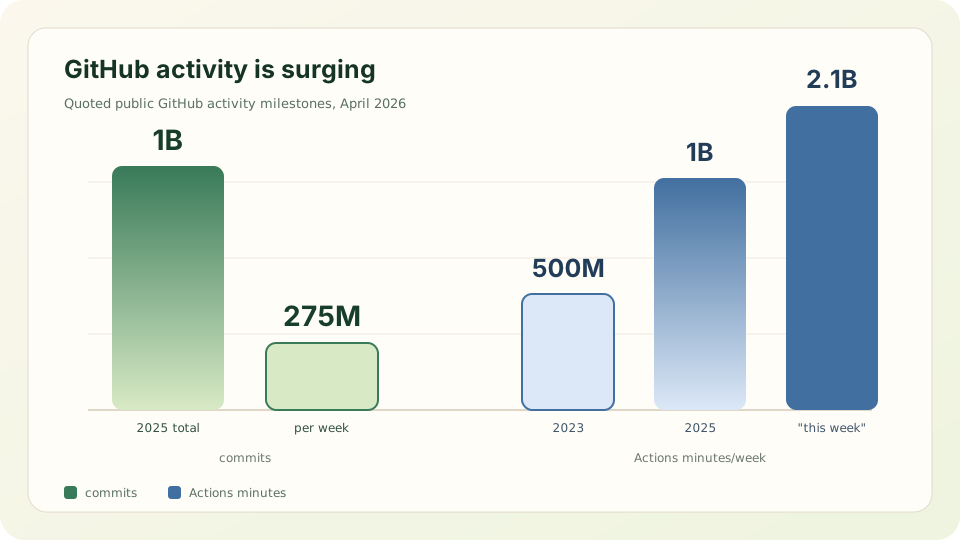
That surge brings real good and real pressure. Issues arrive longer and noisier; pull requests arrive larger and more often. Even strong, well-funded teams struggle to keep pace — and most open source is not maintained by strong, well-funded teams. It is the work of volunteers, historically underappreciated and underpaid, without whom software as we know it would not run.
The tools meant to help can add to the load, and some popular projects have shut off their issue queues and PR permissions in response. Maintainers who do lean on agentic tools face a different bill: alongside their free time, they now burn their own cash on compute — and the affordable era of frontier models won't last.
Something has got to give. These people and projects need more support.
Introducing Open Public (opub)
We link donors to open source projects. Donations fund access to over 30 leading coding models. Token usage is public. Donors know their generosity went toward the projects they support.
When donations are received, OpenRouter API keys funded by donated compute give maintainers on-demand access to leading models for whatever helps them keep up.
They might:
- use GitHub's Copilot CLI to manage GitHub issues and PRs
- Continue.dev to review and audit incoming PRs
- use Claude's security skill to audit for vulnerabilities
- spend raw tokens for development and fixes through popular harnesses like Claude Code, OpenAI Codex, Mistral Vibe, or OpenCode
Spend events appear on the opub project page, so donor impact is visible in the project ledger. If a maintainer's agentic session starts through the opub open source CLI, compute usage is considered Linked: donors can see that spend was tied to the compute key and project session they funded.
Maintain an open source project?
opub helps projects receive donated compute.
Have a public open source project with 100 or more GitHub stars? Get $50 in starter donated compute for use with over 30 top coding models.
The juice to stay afloat
Maintainers already have work that donated compute can help with.
We turn donations into donated compute: project balance maintainers can spend on model token usage, the juice of agentic coding.
Through opub, the unit of trust is at the project level:
- an opub project represents and verifies a public GitHub repository + maintainer
- a donation funds one project's compute balance
- maintainers make compute keys with dollar limits to consume the balance
- token spend appears within the public project ledger
- if the CLI is used, Linked sessions show funded compute was launched from the right project context
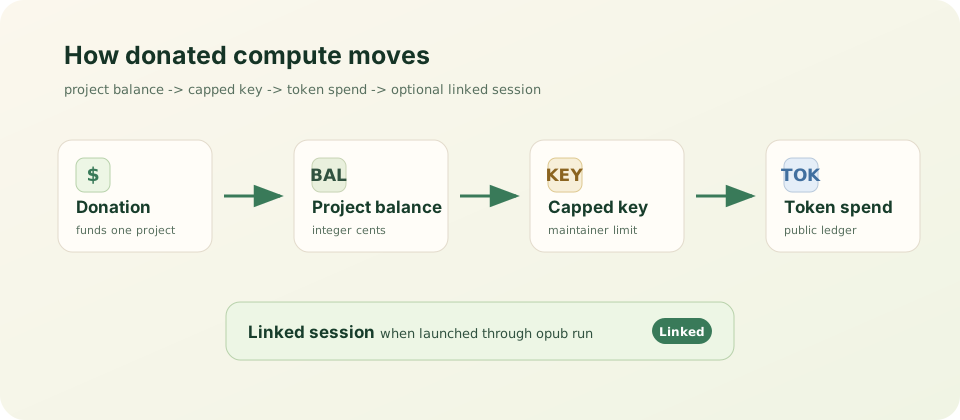
To correlate spend with the project, we do not need to observe prompts, responses, diffs, files, commits, or pull requests. It's a clean, transparent way to ensure the projects you appreciate and rely on won't fall behind the agentic flood.
The founding round
Our goal is to amplify the health of the open source ecosystem. Any public GitHub repository can register now. To celebrate our launch and welcome project maintainers, the first 20 eligible verified projects with 100 or more stars get $50 in starter donated compute from opub.
After registration, connect a GitHub repository to receive your own Open Public project page. Projects outside the starter grant are welcome too: register, share the page, receive donations, and create compute keys once the project has balance.
Share your project page on social media, put it in your README, and point your community to it when people ask how to support the project. opub will surface registered projects wherever it can.
Once someone has donated to your project, you can create a key and spend that balance on calls to leading models such as:
- Claude Sonnet 4.6 (
anthropic/claude-sonnet-4.6) - Claude Haiku 4.5 (
anthropic/claude-haiku-4.5) - GPT-5.5 (
openai/gpt-5.5) - GPT-5.4 (
openai/gpt-5.4) - GPT-5.4 Mini (
openai/gpt-5.4-mini) - GPT-5.3 Codex (
openai/gpt-5.3-codex) - Codestral 2508 (
mistralai/codestral-2508) - Devstral (
mistralai/devstral-2512) - MiniMax M2.5 (
minimax/minimax-m2.5)
There are over 30 models at various costs, all served at their standard rates.
See the documentation for the full list of Available models.
What maintainers can do
After a project has available balance, a verified maintainer creates a compute key with a dollar limit. The limit is chosen by the maintainer and reserved from the project balance. Multiple active compute keys are allowed, so a project can keep setup flexible, rotate keys, or separate workflows without exposing unlimited spend.
Each key is shown once in the browser. After that, the secret belongs in the maintainer's local credential store or direct tool configuration.
The key can be used two ways:
- run a supported agent through the opub CLI for a Linked session
- paste the key into any compatible OpenAI-formatted workflow for direct, unlinked use
Both paths spend from the project balance. When the CLI path links the session, donors can see that compute was spent through a linked project context.
Linked sessions
Session linking is not required, but it sends a strong signal to donors.
The opub CLI wraps the agent harness launch:
opub setup codex --project owner/repo --compute-key-id ck_...
opub run codex
opub setup stores the compute key in the system credential store and writes non-secret agent configuration. opub run starts the agent with the right credentials and refreshes a local, secretless MCP session for project context.
That session context can say which project, compute key, and agent were launched. It does not prove what the maintainer typed, what the model answered, which files changed, or which issue was fixed.
We do not and will not observe, train on, or collect prompts or prompt responses. Our method of session linking is open source and relies on MCP and agent-side skills to report session state. Donors get a useful public signal without turning maintainers' workspaces into surveillance systems.
The CLI supports popular agentic coding harnesses such as:
- Claude Code (
claude) - Codex (
codex) - GitHub Copilot CLI (
copilot) - Vibe (
vibe) - OpenCode (
opencode) - Continue (
continue)
The OpenRouter API key can also be used directly with compatible OpenAI-formatted tooling. That path is unlinked, but spend still accrues to the project balance.
What comes next
We're excited to see what maintainers can do with greater access to today's leading models. Not every project needs this — there's no pressure to register if agentic coding tools aren't part of your workflow. But for those who are already using them, opub can take the cost off your plate.
This blog will publish content to help maintainers get the most out of donated compute, and profile the maintainers using it to build and refine the projects developers rely on.
May no maintainer be left behind.
Written by Kellen E.
Filed under launch, donors, maintainers, opub-cli
Subscribe to the newsletter
Hear from open public.
Rare and concise letters with our latest writing, sponsorships, and updates.
Next up
Reviewing pull requests on donated compute
Jun 13, 2026 / 6 min / opub-cli, agents